How to Identify Pure Kashmiri Mongra Saffron vs Fake or Dyed Threads (5 Purity Tests)
Five objective physical, chemical, and ISO 3632 tests to distinguish genuine Pampore Mongra saffron from dyed corn silk, safflower, and sugar-weighted threads.
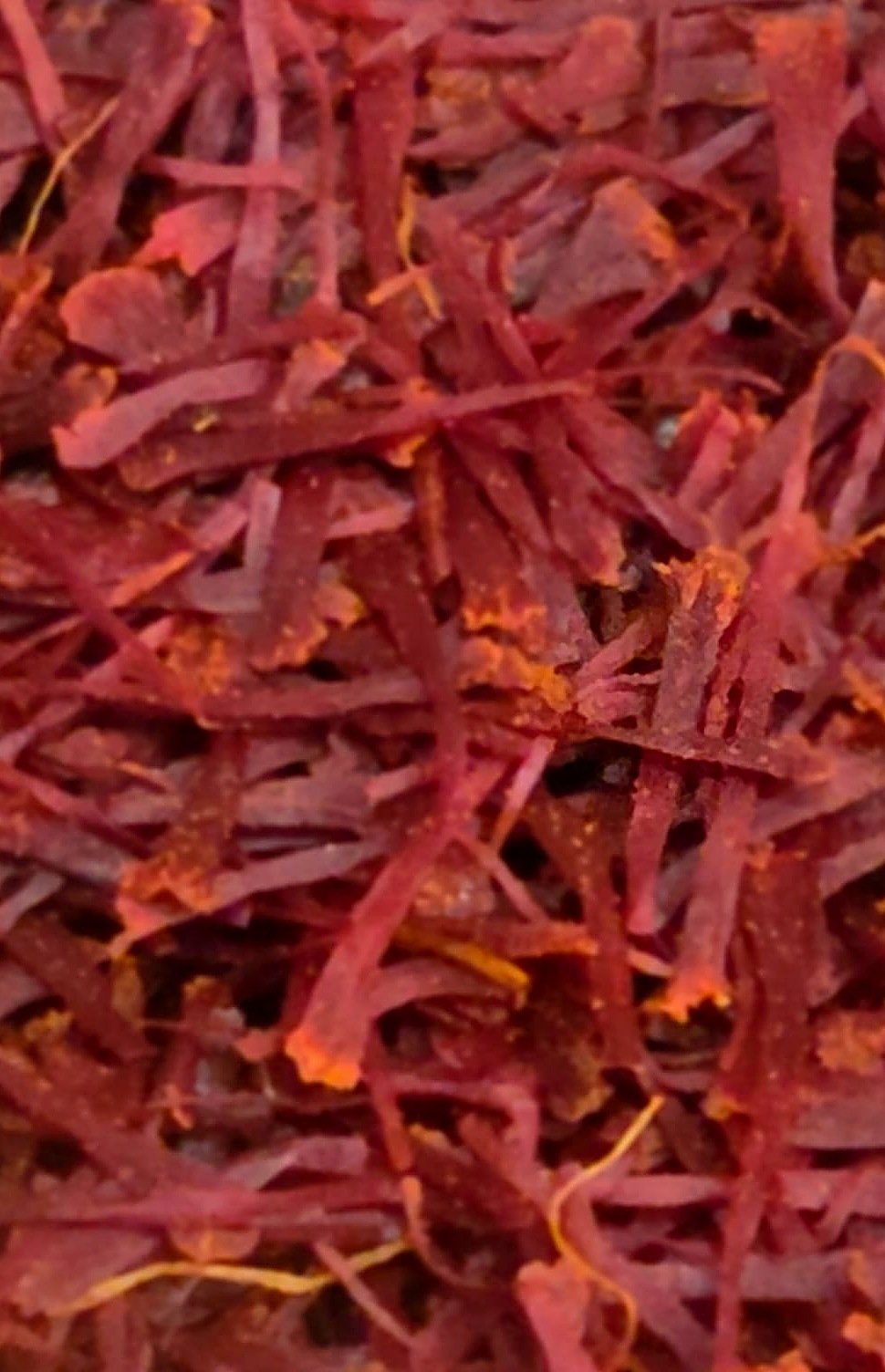
1. The 15-Minute Water Crocin Bloom Test (Never Instant Red): Drop two dry saffron strands into a clear glass of room-temperature or 70°C warm water without stirring. Authentic Pampore Kashmiri Mongra saffron releases natural water-soluble Crocin slowly over 10 to 15 minutes, turning the water a luminous, transparent golden-yellow while the stigma itself retains its deep crimson colour. Counterfeit threads coated in synthetic azo or Ponceau red dyes bleed an immediate opaque red or orange cloud within 15 seconds and leave pale, washed-out fibres behind.
2. Flared Trumpet Tip Morphology: Inspect a single dry strand closely against white paper. Genuine Crocus sativus stigmas from Pampore exhibit a slender dark-crimson stem that flares distinctly into a flattened, notched trumpet crown at the upper tip. Safflower petals, dyed corn silk, and shredded botanical substitutes remain uniform and cylindrical from end to end with no trumpet flare.
3. Bitter-Floral Taste vs Sweet Adulteration: While pure saffron smells warmly honeyed, woody, and hay-like due to volatile Safranal, touching a single thread to the tongue must taste distinctly earthy and pleasantly bitter—never sweet. Unscrupulous traders spray lower-grade threads with sugar syrup, honey, or glycerine to artificially inflate weight by 20% to 35%. Any sweetness on the tongue indicates added weight adulteration.
4. The Sodium Bicarbonate (Baking Soda) Check: Dissolve a small pinch of baking soda in a cup of water and add two saffron threads. Pure Crocus sativus reacts by releasing a clean, bright yellow tint from natural Crocin carotenoids. Artificially dyed threads typically turn murky reddish-orange or brownish-pink.
5. Pre-Unsealing ISO 3632-2 Laboratory Verification: Kitchen checks catch crude street counterfeits, whereas sophisticated dye or moisture manipulation requires accredited optical spectrophotometry and HPLC screening. Every ZAFORA 1.00 g coffret carries an outer QR Batch Passport (such as Lot ZAF-KS-2026-014, verified at Crocin 238 at 440 nm, Picrocrocin 91, Safranal 34, and 0.00% synthetic dyes) so you can inspect the laboratory Certificate of Analysis before breaking the inner food-hygiene tamper seal.
Inspect Batch ZAF-KS-2026-014 or Acquire Signature 1.00 g Coffret
Why harvest timing on the 1,600-meter karewa plateaus protects volatile safranal before the Himalayan sun rises.
A collector's plain-language guide to reading Crocin, Picrocrocin, and Safranal laboratory values—and what they do and do not establish.
Visualizing 480 crimson strands—how to bloom saffron at 70°C and why a single gram flavours twenty-five memorable tables.
Why Pampore's 1,610-meter Himalayan karewa alluvium produces thicker crimson stigmas and higher per-strand Crocin potency than lowland commercial saffron.